Overland Park, KS · Garage Door Service
Mission's houses date mostly to the early 1970s, which means older torsion hardware and steel panels. We drive in from Overland Park, 10 miles out, to fix what breaks.
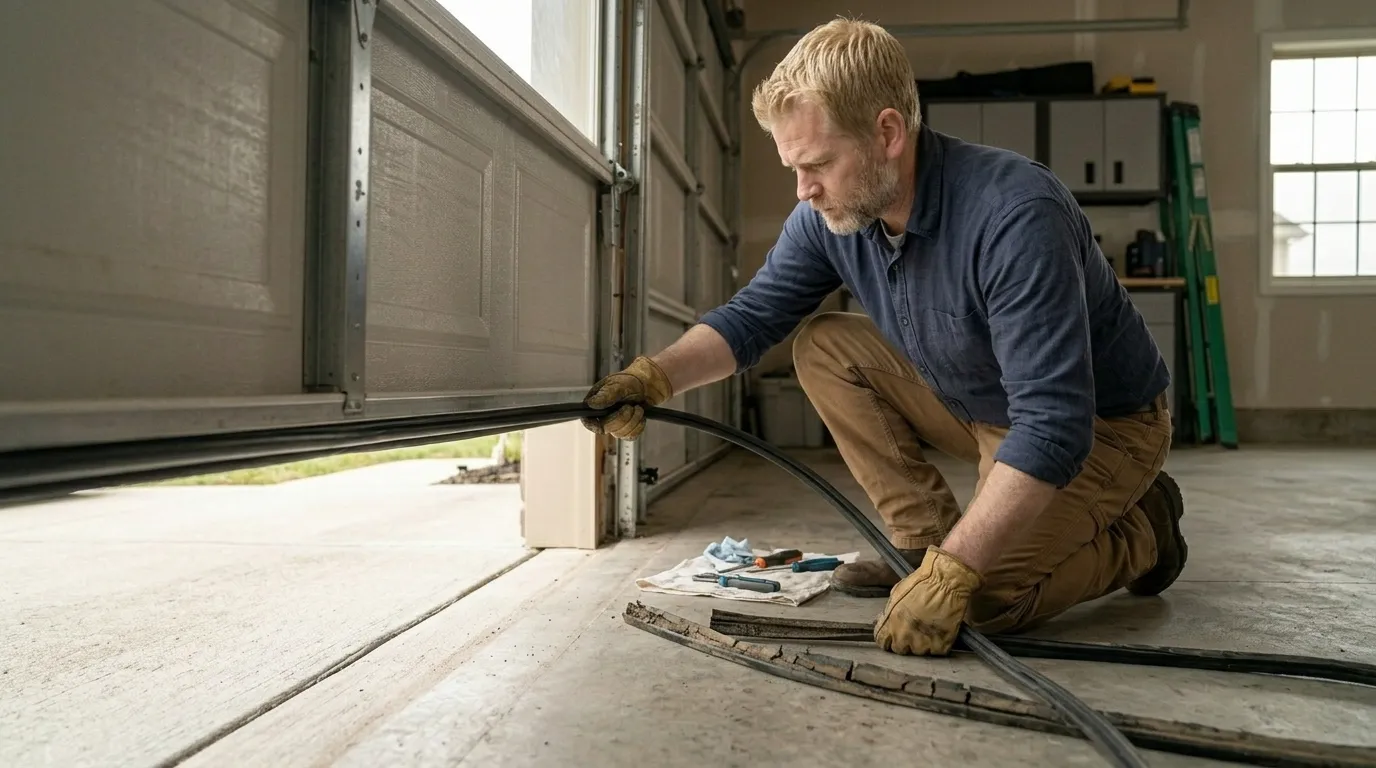
Before we talk about the broken spring or the cable off the drum, look at what's actually hanging in the opening. Mission's houses went up mostly around 1973, right in the middle of the 1950-2004 build window that covers this whole service area, and that means a specific kind of door: single or double-layer steel, sized to openings that were standard in the '60s and '70s, often still running on the torsion hardware that came with the house.
We cover Mission from Overland Park, about 10 miles out. We won't promise you a fixed arrival window here the way a shop based in town might - that's the honest limit of working from a next-door base rather than a Mission address. What we can tell you is that once we're on site, most jobs on doors this age are straightforward: a broken spring, a snapped cable, or a roller worn out of its track are common failures on hardware that's been doing its job since before anyone reading this owned the house. Panel damage from an impact takes longer if we have to match steel gauge and section height to an older door that isn't stocked off a current shelf.
Call when the door won't move, won't stay up, or the spring has let go with a bang. We'll tell you honestly on the phone whether it sounds like a same-day fix or a part we need to order.
For a house built in the early '70s, the door itself is usually steel, either a single layer with no insulation or an early double-layer with a thin foam core, hung on standard-width torsion springs sized for a lighter door than what's sold today. We carry torsion springs in the common wind and wire sizes that fit these openings, extension spring sets for the older lift systems some of these houses still have, and standard rollers, cables, and hinges that match sectional doors from this era.
What we don't carry on the truck is a rare panel color or a discontinued profile - if a section is cracked or dented on a door this old, we're often looking at replacing the whole door rather than hunting for one matching panel, because the manufacturer stopped making that exact profile years ago. That's not us upselling you; it's just what happens with 50-year-old steel.
Openers on these houses are a mixed bag - some original chain-drive units are still running, others have been swapped at least once. We stock standard drive gears, belts, and safety sensor kits that cover most residential openers currently on the market, plus the parts to convert an old chain-drive setup to belt if that's what you want done while we're there.
What a repair runs depends on what's actually broken and how old the hardware is. A torsion spring swap on a standard double door is a different job, and a different cost, than replacing a snapped cable or resetting a door that's jumped its track. Panel damage is the wildcard - if we can match the section, it's a repair; if we can't, because the door is old enough that the manufacturer no longer makes that profile, you're looking at a full door replacement instead.
Mission's household income runs lower than the wider service area's median - $74,396 here against $90,982 across the full area we cover. That gap matters for how we talk about a job on site: on a door this age, repair is usually the right call financially unless the springs, cables, and panels are all failing at once, in which case sinking money into patchwork repairs on 50-year-old steel doesn't make sense compared to one new door.
We don't quote a number without seeing the door and the spring size. Anyone who tells you a flat price over the phone for a torsion spring job hasn't looked at your hardware yet.
A torsion spring under tension can break a hand or worse if you don't know what you're doing, and on a house this age the spring has likely never been replaced, which means it's wound tighter and more brittle than a newer one. We'd rather you call than reach for a wrench on that one.
What you can check yourself: whether the door is binding on the track, whether a roller has come out of its channel, whether the opener's safety sensors are lined up and clean. Those are visual checks, no tools with tension involved. If the door slams down instead of lowering smoothly, or a cable is frayed and hanging loose, stop touching it and call - that's a spring or cable failure, and on hardware from the '70s the failure point is usually more worn than it looks.
Honest limitation: we don't walk people through spring replacement over the phone, and we won't sell you a spring to install yourself. It's not a liability line - it's that the wind direction and wire gauge have to match the door exactly, and getting it wrong on an old torsion setup is how people get hurt.
This is a cold-moderate climate area, and steel doors from the '60s and '70s move with the temperature more than newer insulated ones do. A door hung in 1973 wasn't built with the foam core that buffers today's doors against a hard freeze, so the steel contracts, the panel seams tighten, and a spring that's already fifty years into its working life is more likely to let go on a cold morning than a mild one.
Across the 15 named areas near Mission, most of the housing stock dates to the 1960s and '70s, which means a lot of doors are still running on the torsion or extension hardware they were built with. Springs have a rated cycle count, and a spring installed when the house was new has been through a lot more open-close cycles than anyone tracking it would guess. Add a winter cold snap on top of that and a spring near the end of its life is the single most common emergency call we get out this way.
Track misalignment is the other frequent cause - decades of settling on an older foundation shifts the opening just enough that rollers start binding, especially on doors that have never had the track adjusted since installation.
We don't have a branch in Mission - we run out of Overland Park, about 10 miles away, and cover Mission from there. It means we can't promise the same arrival window a town-based shop might, but the trucks carry the same parts and the technician does the same job on site.
Not for Mission. Most houses here date to around 1973, and a lot of torsion springs never get replaced until they break. A spring that old has been through far more open-close cycles than a newer one, which is exactly why it tends to be the part that fails first.
Depends what's broken. A spring or cable is almost always a repair. A cracked or badly dented panel on a 50-year-old door is often a replacement, because the exact profile isn't made anymore and matching one section isn't realistic.
We wouldn't recommend it, especially on hardware this old. The wind direction and wire gauge have to match exactly, and a spring under tension can cause serious injury if it's mishandled. We don't sell springs for self-install.
Call now or request a free quote - same-day service on most repairs, upfront written pricing.