Overland Park, KS · Garage Door Service
Garage door jumped its track in Overland Park? Here's what causes it in homes built from the 1950s through 2000s, how long fixes take, and when to call a pro.
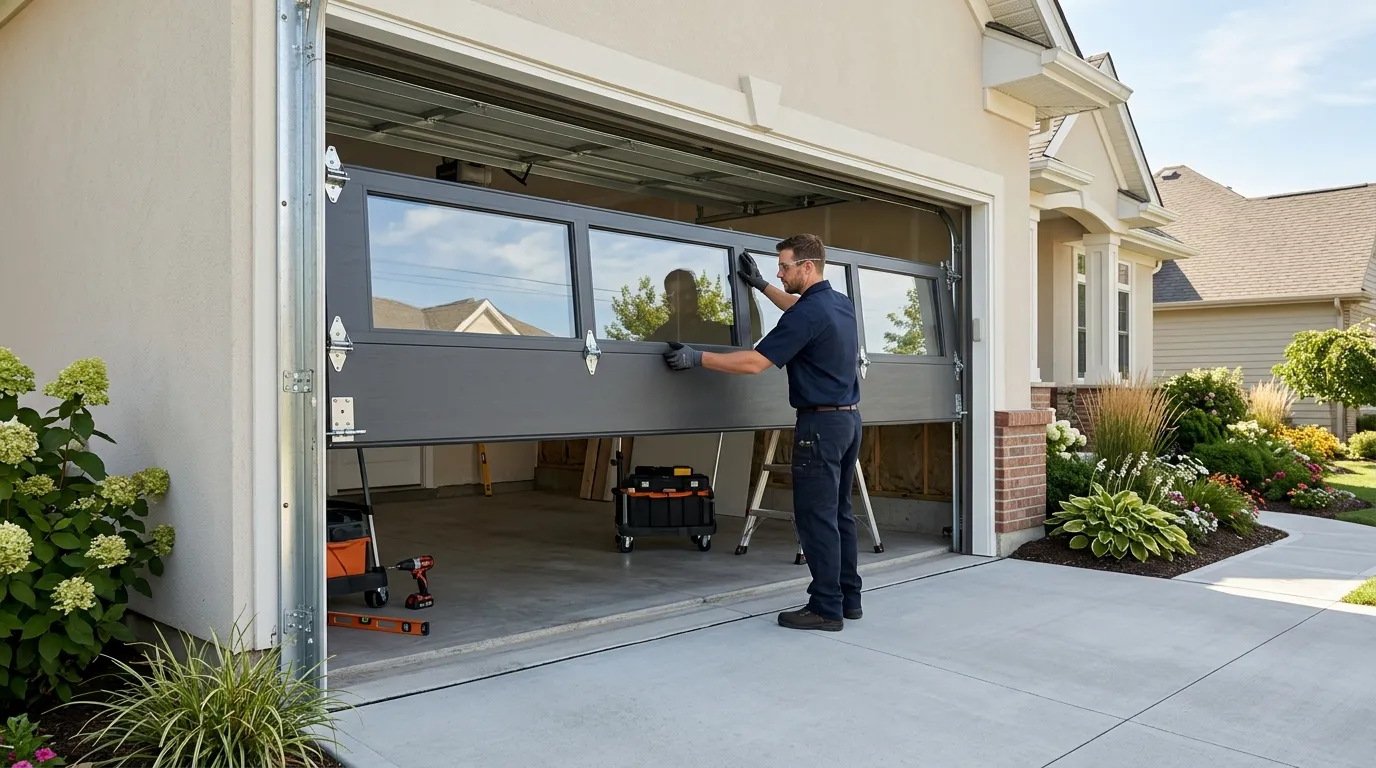
An off-track door is rarely an all-day repair, but the honest answer is "it depends on what's actually wrong." If a roller has simply popped out of the track and the door is sitting crooked but the cables are intact, a tech can usually reseat it, check the track alignment, and have the door running true again in one visit. If the track itself is bent - which happens when a car bumps it or someone forces a stuck door - that section gets replaced rather than hammered back into shape, because a hammered track will slip again within months.
The part that adds time isn't the labor, it's parts on hand. Standard steel track sections and rollers are common stock. Older hardware sizes, especially on doors that predate current bracket spacing, sometimes need a supplier order. We don't carry every legacy bracket on the truck, and pretending otherwise would just mean a second trip. If your door is one of the older builds common across this area, ask up front whether the fix is same-visit or needs a part ordered - it's a fair question and we'll give you a straight answer before we start.
An off-track garage door usually announces itself before it fully derails. You'll see the door hanging unevenly in the opening, one bottom corner lower than the other, or a visible gap where a roller has come free of the track rail. Sometimes it's noisier first - a grinding or popping sound as a roller rides the edge of the track instead of sitting inside it, or a door that jerks and stutters partway through its travel instead of moving smoothly.
In worse cases the door stops moving entirely, jammed at an angle with the opener straining against it - at that point, stop using the opener. Running the motor against a jammed, off-track door strains the opener and can bend the track further or snap a cable under load.
A related but different problem is a door that looks aligned but shudders at one specific point every cycle - that's often a bent track section rather than a dislodged roller, and it's worth telling us which one you're seeing when you call, since it changes what we bring on the truck.
This area's housing runs mostly 1960s and '70s construction, with the broader build window stretching from 1950 to 2004 and a median build year around 1977. Doors and track hardware installed during that stretch have had decades of thermal cycling to work on them. Overland Park sits in a cold-moderate climate band, which means real freeze-thaw swings every winter - steel track brackets and lag screws expand and contract with the seasons, and over enough winters that movement walks fasteners loose and lets brackets drift out of plumb.
A loose or shifted bracket doesn't announce itself. The door still opens for months, running slightly off true, until a roller finally rides far enough off the rail edge to jump it. That's more common on original hardware from the older end of this area's build stock than on anything installed in the last decade, since older track wasn't engineered for the heavier insulated panels a lot of homeowners have since added. Cold mornings make it worse - stiff grease and a slightly misaligned track are a bad combination, and that's usually when we get the call.
If a single roller has popped just barely out of the track and the door still opens and closes by hand without binding, you can sometimes coax it back in yourself - open the door partway, hold it steady, and gently guide the roller back into the rail with a gloved hand while a second person watches. If it resists at all, stop. Forcing it bends the track, and a bent track is a parts replacement, not a five-minute fix.
What you should not do yourself: touch anything if the door is under spring tension and hanging crooked, or if a cable has come off its drum. Torsion springs store enough force to cause serious injury, and an off-track door under load is exactly the situation where that tension is unpredictable. That's the honest limitation here - we'd rather talk you out of a DIY attempt on the phone than reset a dislocated shoulder later. If the door won't move freely by hand, or if it's off track at more than one point, that's a call, not a weekend project.
It's rarely sudden - the hardware has usually been drifting for a while. Seasonal temperature swings loosen track brackets a little each year, and once a roller edges far enough off the rail, it finally jumps. The lack of warning is normal; the loosening happened over winters, not overnight.
No. Running the opener against a jammed or off-track door puts strain on the motor and the cables that isn't part of their normal job. It can bend the track further or snap a cable under load. Switch to manual only if needed, and don't force the opener.
Usually the bent section, not the whole track. Track comes in bolted segments, so a tech typically swaps the damaged piece and reuses the rest. Hammering a bent section back into shape almost never holds - it looks fine for a while, then slips again.
By Neighborhood
We also handle off track repair in these Overland Park-area suburbs.
Call now or request a free quote - same-day service on most repairs, upfront written pricing.