Overland Park, KS · Garage Door Service
Broken torsion springs are common in Overland Park's 1960s-70s housing stock. Same-day spring replacement across the service area, KS climate rated parts.
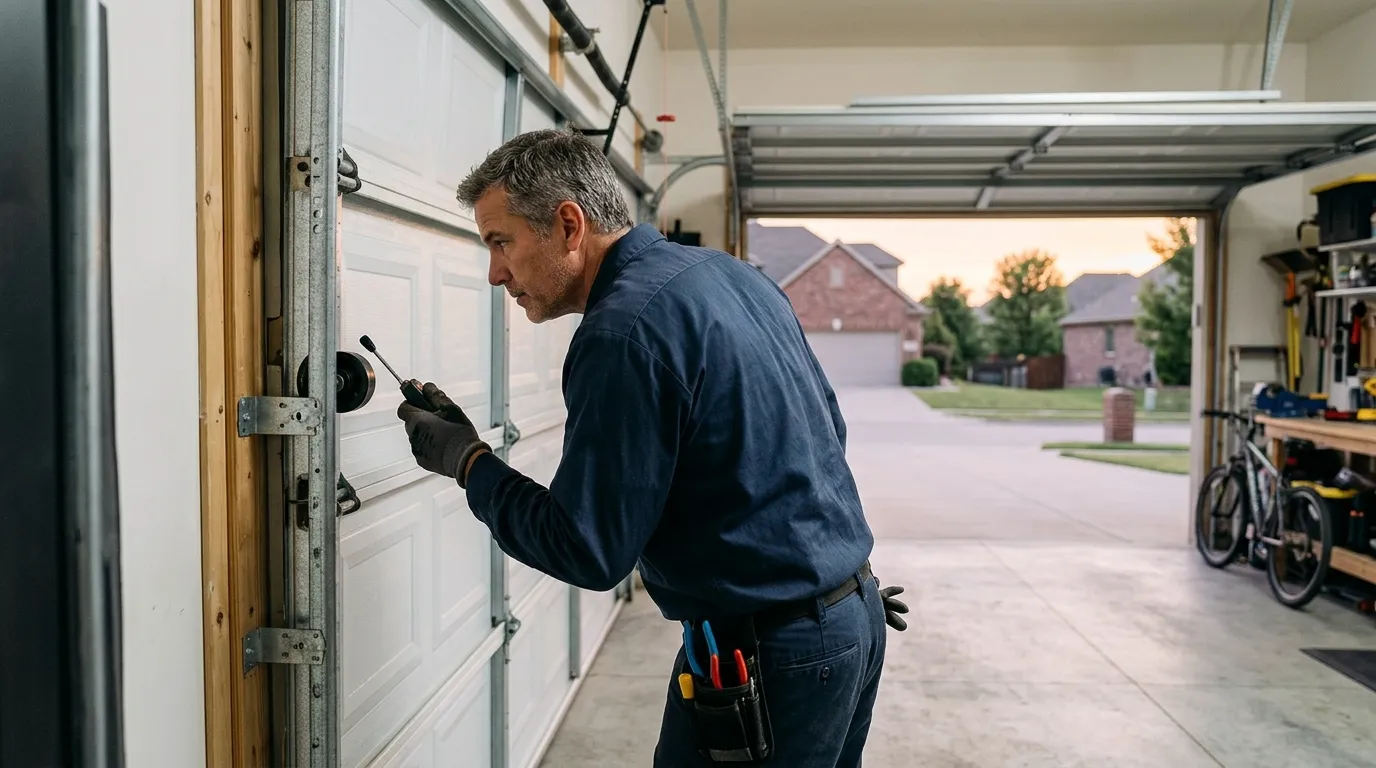
A torsion spring job is one of the more predictable calls we run. Once we're at the door, we measure the wire size, the coil diameter, and the wind length, pull matched springs off the truck, and do the swap on the same visit in most cases. Extension spring jobs on older sectional doors go a little faster since there's no cable drum work involved.
What changes the timeline isn't the repair itself - it's getting to the right door. We cover a wide radius, from Leawood four miles out to Louisburg nineteen miles south, plus Corporate Woods, Executive Hills, Oak Park, and a dozen other named areas in between. A spring that snaps at 7am in one part of the territory and one that snaps at 7am on the far side of it don't get fixed at the same minute, even if the repair on the bench takes the same twenty minutes.
We don't quote a fixed window here because it depends on where you are in that radius and what's already on the schedule. What we can tell you is that once the truck is in your driveway, spring replacement is not a multi-day job. It's parts we carry, not parts we order.
A door that won't budge, or one that slams down the last foot of travel - that's a broken torsion spring almost every time. The opener isn't the problem; it's fighting a door that now weighs what it weighs without a working spring to counterbalance it. You might hear a loud bang from the garage days or weeks before the door actually fails - that's the spring itself snapping under tension, even though the door still looked fine at the time.
On older doors around here, built during the run of construction from 1950 through 2004 with the bulk going up in the 1960s and 70s, you're more likely dealing with a single torsion spring on a side-mount torsion bar, or in some cases a pair of stretched extension springs along the horizontal tracks. Both fail the same basic way - metal fatigue after thousands of open-close cycles - but they look and sound different when they go. A snapped torsion spring usually leaves a visible gap in the coil above the door. Extension springs tend to separate at the end hook or the safety cable will be the only thing holding a broken piece in place.
Either way, if the door is heavier to lift by hand than it used to be, or the opener strains and reverses on the way down, don't keep running it. That's the spring, not the motor.
Torsion and extension springs fail from cycle fatigue no matter where they're installed, but a few things about this service area push that fatigue along faster. The housing stock is old enough to matter - median build year 1977, with most of the territory's houses dating 1950 to 2004 - so a large share of garage doors out here are still running original or first-replacement hardware that's decades into its cycle life.
The climate band here is cold-moderate, which means steel springs go through real freeze-thaw stress every winter: the metal contracts in cold weather, tension on the coil increases, and a spring that was already near the end of its rated cycles is more likely to snap on a cold morning than a mild one. That's not a dramatic weather event, just steady seasonal stress added on top of ordinary wear.
Across the service area's 35,227 owner-occupied houses, a lot of garages still carry torsion hardware installed the decade the house was built. Nobody replaces a spring before it breaks, so the failure rate tracks the age of the housing stock pretty closely - older sections of the territory call more often than newer ones.
A torsion spring is wound under enough tension to break bones or worse if the winding bars slip. Extension springs are lower tension but still capable of launching if a hook fails while you're working near it. This isn't a job we recommend tackling with a socket set and a YouTube video, and we'll say that even though it costs us nothing to say otherwise.
Where DIY does make sense: replacing worn rollers, lubricating hinges and tracks, tightening loose hardware, or swapping weatherstripping. None of that involves stored spring tension and none of it will hurt you if you get it slightly wrong.
One honest limitation on our end - if your door is old enough and worn enough that the track, drum, and bearing plate all need attention alongside the spring, sometimes a full spring-and-hardware job costs close to what a new door section would run. We'll tell you that up front rather than patch something that's going to need a second call in six months. Given how much of the local stock dates back to the 1960s and 70s, that conversation comes up more here than it would with newer construction.
If the door is hard to lift by hand when the opener is disconnected, or the opener strains and reverses partway down, the spring isn't doing its job counterbalancing the door's weight. A bad opener usually shows different symptoms - clicking without movement, or the light blinking with no motor sound at all.
Most of the service area's housing was built between 1950 and 2004, with a lot of it from the 1960s and 70s. Springs have a rated number of open-close cycles, and hardware from that era is well past its original life expectancy, so it's the age of the coil, not anything unusual about the doors themselves.
Yes. In a cold-moderate climate, steel springs contract in cold weather, which raises tension on a coil that may already be near the end of its cycle life. It's not a single weather event causing the break, just added seasonal stress on top of ordinary wear.
You can, but the second spring is usually close behind in cycle wear if it's the same age. Most jobs where one spring has already gone, we'll flag the second one so you're not paying for a return trip a few months later.
By Neighborhood
We also handle spring repair in these Overland Park-area suburbs.
Call now or request a free quote - same-day service on most repairs, upfront written pricing.