Overland Park, KS · Garage Door Service
Opener repair for Prairie Village homes, most built around 1959. We drive the 7 miles from Overland Park to fix chain drives, dead sensors, and worn gears.
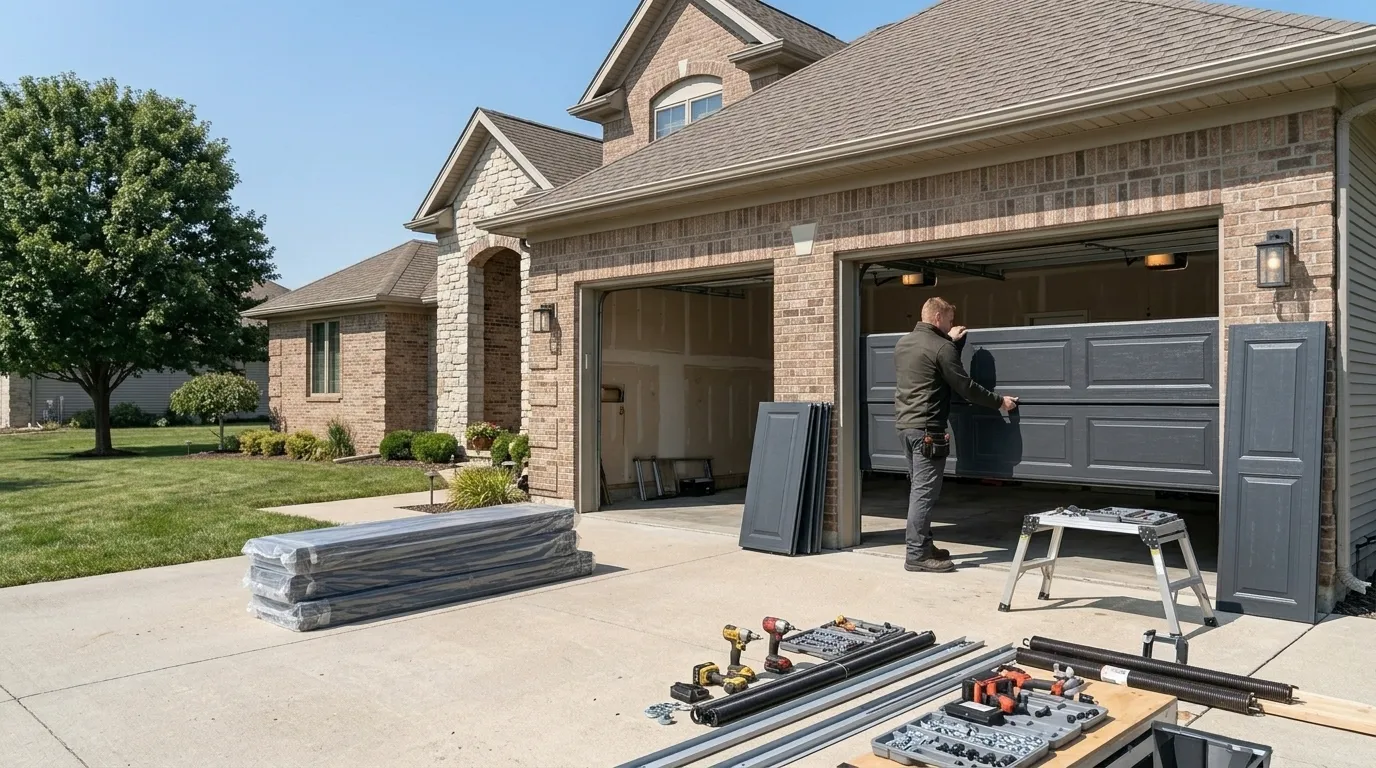
The drive from Overland Park to Prairie Village is about 7 miles, close enough that a call here runs the same day but far enough that we ask a few questions before loading the truck - what the opener does when you press the button, whether the light blinks, whether the door moves at all. That matters more in a neighborhood like this one, where most houses went up around 1959. Openers in these homes have usually been replaced once or twice already, but the wiring paths and header clearance still follow the original 1950s framing, which is tighter than what you'd find in a house built in the 1980s.
The common failure we see on these older setups is a worn drive gear inside the unit - a plastic part that strips after years of use, especially on chain-drive openers that were the standard replacement choice for this housing stock. The second most common is a failed capacitor or logic board on units pushing 15-20 years old, which is a normal age for an opener in a house this old to be on its second or third motor. Winters here are cold enough that older openers with worn lubrication in the gearbox will bind and trip the breaker on the first hard freeze, which is when we get most of these calls.
An opener repair on a 1959-era house goes sideways when the header bracket the opener bolts to has never been touched and the mounting wood has dried out over sixty-some years. We've had to reinforce a bracket before we could even hang a new motor, and that's not a five-minute add-on - it changes the job.
It also goes sideways when a homeowner has already swapped the opener once, sometimes twice, and the wall control or safety sensors are a mismatched generation from the head unit. We've opened junction boxes here and found three different eras of wiring spliced together by three different installers. Sorting that out costs more time than the repair itself, and we tell people that up front rather than surprise them on the invoice.
The other place it goes sideways: sensors that look aligned but aren't, because the bracket they're mounted to has shifted with the house settling over decades. A level that reads fine by eye can still be off enough to make the safety reversal fail intermittently, which is the kind of fault that looks like the opener is haunted until you actually measure the eye alignment with a level.
Some of this you can check yourself before calling anyone. If the opener hums but the door doesn't move, that's almost always the gear or the drive belt/chain, not something you fix with a screwdriver and a Saturday afternoon - the housing has to come apart and the part has to match your model.
If the wall button does nothing but the remote works, that's usually a bad wire run or a dead wall station, and that one is fair game for a homeowner comfortable with a multimeter. Anything involving the torsion spring, the cables, or the opener's force settings on a door that's binding - leave that alone. Those aren't opener problems even when they look like one, and we'd rather tell you that on the phone than let you spend an afternoon adjusting the wrong thing.
One honest limit: if your opener is the kind with a discontinued logic board - common on some of the older chain-drive units still running in houses from this era - we may not be able to get the exact part. At that point replacement is the faster and cheaper answer, and we'll say so instead of chasing a part that's been out of production for years.
A door that reverses right after touching the floor, every time, points to the down-force setting or a sensor issue, not the spring. A door that opens fine but won't close unless you hold the button points to the safety sensors - dirty lenses, a stray cobweb, or a bracket knocked an eighth of an inch out of true. Either is a quick fix once we're on site.
A grinding or clicking sound from the unit itself, especially right before it stalls, is almost always the drive gear we mentioned earlier - the part most likely to wear out in an opener that's been running in a Prairie Village house since somewhere in the 1990s or 2000s, a second or third-generation replacement on a home built around 1959.
If the opener runs but the door lags a second before moving, or the motor sounds like it's working harder than it used to, that's often the capacitor going, and it tends to fail completely within a few weeks of that lag showing up. Catching it before full failure means you're not stuck with the car in the driveway on a cold morning.
About 7 miles. It's a short drive, so same-day opener calls are routine - we just ask a few diagnostic questions on the phone first so the truck comes loaded with the right part.
Unlikely on its own, but the house itself is probably original-era. Most homes in Prairie Village were built around 1959, and the opener has almost certainly been replaced at least once, sometimes twice, since then.
Depends on the part. A stripped gear or bad sensor is a cheap fix. A discontinued logic board on an older chain-drive unit often isn't worth chasing - replacement ends up faster and cheaper, and we'll tell you which situation you're in before we start.
Call now or request a free quote - same-day service on most repairs, upfront written pricing.