Overland Park, KS · Garage Door Service
Prairie Village's 10,054 households sit on 1959-median housing stock, which means specific spring types and failure patterns. Overland Park Garage Door Pros drives the 7 miles out to fix them.
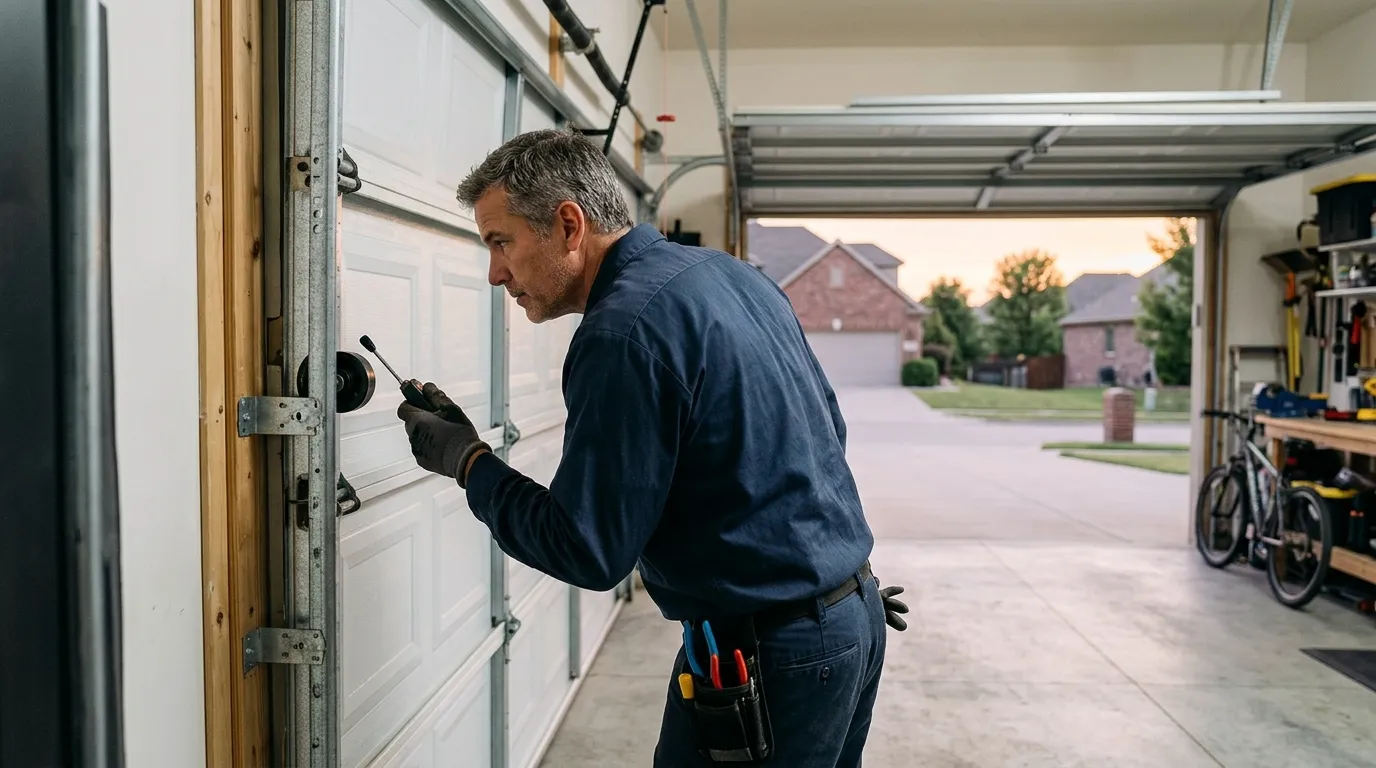
Prairie Village has about 10,054 households, and it's a built-out suburb rather than one still filling in new subdivisions. That matters for spring work because the housing stock doesn't have much variety in it - you're not fixing a mix of 1985 doors and 2020 doors on the same block. The median year built here is 1959, right at the front edge of the broader 1950-2004 range across the service area, and it puts most Prairie Village garage doors closer to the original hardware than the newer end of that range.
A lot of these houses got their garage door updated once, sometime in the 1960s or 70s wave that shaped much of the area's stock, which means you'll find either an early sectional door on extension springs or a later retrofit onto torsion hardware bolted to a header that was never really designed for it. Both setups fail in their own way. Extension springs stretch and lose tension gradually, so the door gets heavier to lift over months, not overnight. Torsion springs on an undersized retrofit header tend to fail suddenly, often with a bang, because the header flexes under load for years before the spring itself finally goes.
The job goes sideways when someone treats a 1959-era extension spring setup like a modern torsion job. The cable drums, the pulley brackets, the way the door is counterbalanced - none of it matches what's on the shelf for a newer door, and forcing a modern torsion kit onto an old track system usually means redrilling the jamb or replacing brackets nobody budgeted for.
It also goes sideways when a spring gets replaced but the drums or bearing plates don't, because on a door this old those parts have usually worn unevenly along with the spring. You fix the obvious part and the door still binds or drifts to one side within a season.
The honest limitation here: if the header or jamb has already been reinforced once for a torsion retrofit and it's failing again, sometimes the fix isn't another spring - it's telling the homeowner the door itself, or the frame around it, is past the point where a spring repair is worth doing on its own.
Don't. A garage door spring, extension or torsion, is under enough stored tension to break a hand or worse if it lets go while you're working near it, and that's true whether the door is five years old or original to a 1959 build. On a door this age the risk is worse, not better, because the hardware holding the spring in place has had six decades to corrode, loosen, or get bent by a previous owner's repair attempt.
At a median household income of $107,664 in Prairie Village, most owners we hear from aren't trying to save the cost of a service call by doing it themselves - they're asking whether the door is worth fixing at all versus replacing outright. That's a fair question, and the honest answer usually comes down to the door's age and whether the track and hardware around the spring are still sound, not the spring alone.
If the door feels heavier than it used to, lifts a few inches then stalls, or the opener strains and reverses itself, that's a spring losing tension - gradual, on an older extension setup. If you heard a loud pop or bang and the door won't budge, or one side hangs lower than the other, that's a spring that's already broken, likely torsion.
A gap between the two coils of a torsion spring, visible when you look up at the bar above the door, means it's already snapped even if the door still moves a little. On extension-spring doors, look for a stretched-out spring that's longer than its twin on the other side - that's the one about to go.
Overland Park Garage Door Pros covers Prairie Village from Overland Park, about 7 miles out. See the coverage page for the areas nearby, or the Overland Park spring repair page for how this same repair works closer to home base.
That's almost always a spring losing tension gradually, which is common on the extension-spring setups found on Prairie Village's older, 1959-median housing stock. The spring stretches over time and the opener has to work harder to compensate, until it starts stalling or reversing partway up.
Depends on the header and track, not just the spring. If a previous torsion retrofit already reinforced the frame and it's failing again, a spring alone won't fix it. If the hardware around the spring is sound, a spring replacement is usually the cheaper, faster answer.
No. Overland Park Garage Door Pros is based in Overland Park and drives out to Prairie Village, about 7 miles, for spring repair calls. There's no local depot or drop-in counter here.
Not a good idea. If one spring has stretched or failed, the other one on a door that old is usually close behind it, and running mismatched springs puts uneven load on the track and rollers on one side of the door.
Call now or request a free quote - same-day service on most repairs, upfront written pricing.