Overland Park, KS · Garage Door Service
Serving Gardner, KS from Overland Park, 14 miles out. Gardner's newer housing stock (median build 2002) means different springs and openers than older parts of the service area.
Gardner is the outlier on our coverage map. Most of the neighborhoods we work in went up between 1950 and 2004, with a median build year of 1977 - older torsion setups, original hardware, doors that have outlived a spring or two already. Gardner's median build year runs to 2002, a full generation newer than the rest of the area. That changes what shows up in the truck.
A house built in 2002 almost never has the side-mounted, low-headroom torsion setups we see in the 1960s pockets closer to Overland Park. Instead you're looking at standard torsion springs rated for taller sectional doors, chain or belt-drive openers with safety-reversal sensors as factory standard, and steel panels rather than the older wood or single-layer steel doors from the 1970s stock. The failure points are different too - Gardner calls skew toward opener logic boards, worn nylon rollers, and photo-eye sensor issues rather than the seized shafts and rusted end bearing plates common on 1960s doors elsewhere in the territory.
We travel from Overland Park to reach Gardner, about 14 miles out. That distance doesn't change what we bring - it changes what we expect to find when we get there.
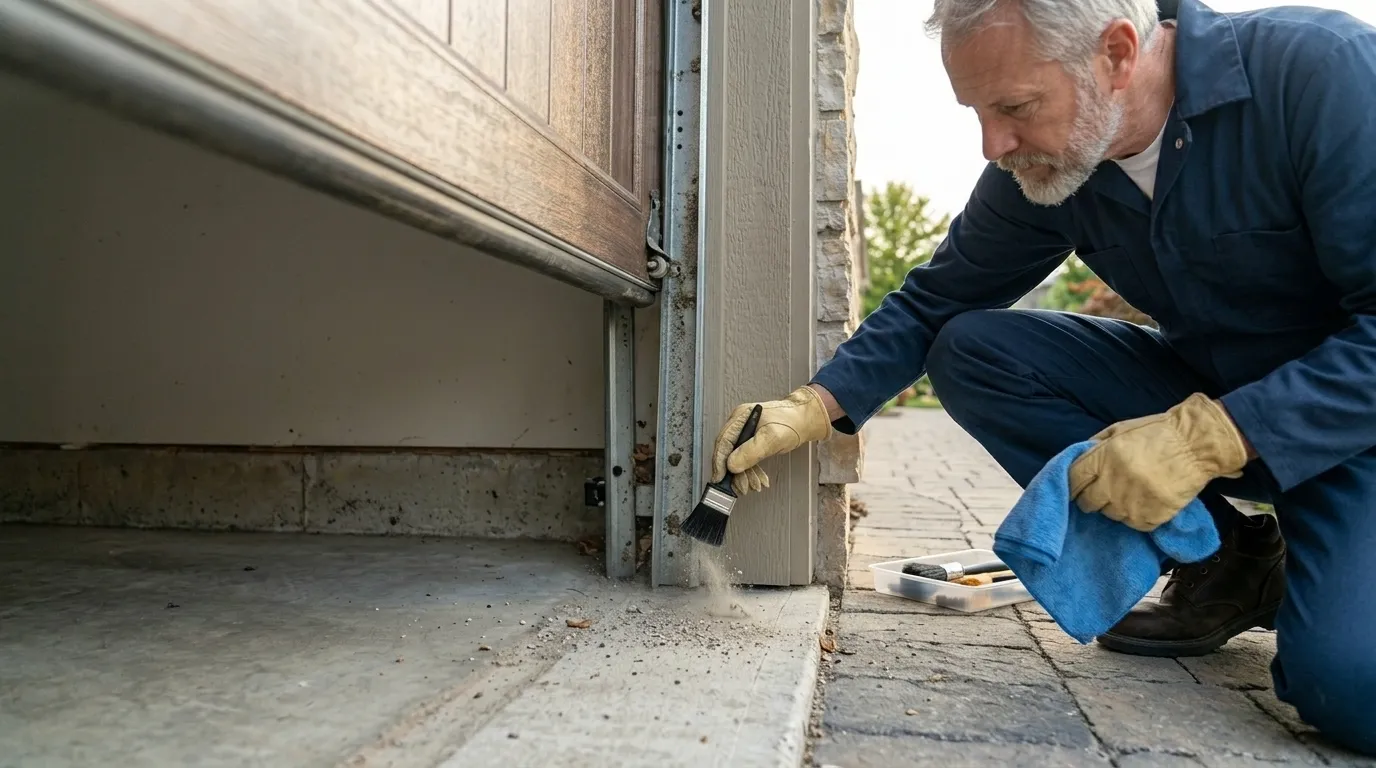
On a 2002-era door, the spring itself usually isn't the first thing to go. We see openers more than springs in Gardner - circuit boards that have logged twenty-plus years of daily cycles, remotes that stop pairing, and safety sensors knocked out of alignment by a bumped bike or a stored ladder. Weatherstripping on doors this age is also due; the vinyl seal along the bottom panel dries out and cracks after two decades of Kansas winters.
Springs still fail, just later in the door's life than on older stock. A standard torsion spring on a 2002 door is now old enough to be near or past its cycle count, so if you're getting a slow-open or a door that won't budge without help, that's often exactly it.
Cold-band winters take a toll on nylon rollers and cable ends regardless of build year, so those are steady work here too. What we don't see much of in Gardner: the low-headroom torsion conversions and wood-panel doors that dominate calls in the older parts of our territory.
Gardner runs about 8,175 households, with a median income near $92,579 - a touch above the $90,982 median across the wider 59,351-household service area we cover from Overland Park. The housing itself tells the real story, though: this area's median build year is 2002, against a service-area median of 1977 spread across 15 named communities and mostly 1960s-70s stock.
That twenty-five-year gap matters more than the income numbers. Newer construction means newer garage door hardware standards, better-insulated doors as a rule, and openers built to modern safety-sensor codes rather than retrofitted onto older openers after the fact. It also means fewer of the oddball non-standard door sizes we run into on 1950s and 60s houses closer to the center of our coverage area.
We don't keep a location or a crew stationed in Gardner - we run out from Overland Park, roughly 14 miles away, so we're not the outfit to call if you need someone standing in your driveway in twenty minutes. If your door failure can't wait and you need the fastest possible response, factor that drive into your decision.
We also don't try to force a repair onto a door that's cheaper to replace. On newer stock like most of what's in Gardner, that's rarely the call - a 2002-era door with a bad opener board or worn rollers is almost always worth fixing rather than replacing. We'll tell you straight when that math flips the other way, but on housing this age it usually doesn't.
No. We're based in Overland Park and drive out to Gardner, about 14 miles each way. We don't keep a depot or crew stationed there, so factor the drive time into how urgent your call is.
Build era. Gardner's housing stock runs newer, with a median build year around 2002, versus the 1977 median across the wider service area. Newer construction came with different opener and safety-sensor standards than the 1960s and 70s doors common elsewhere.
Yes. Openers installed when Gardner's newer homes were built are now old enough that circuit boards, sensor alignment, and remote pairing are common failure points. It's less about the door and more about electronics reaching the end of a normal service life.
Call now or request a free quote - same-day service on most repairs, upfront written pricing.