Overland Park, KS · Garage Door Service
Overland Park houses built 1950-2004 need wider openings for new doors. See what installation takes, what to expect, and when replacement beats repair.
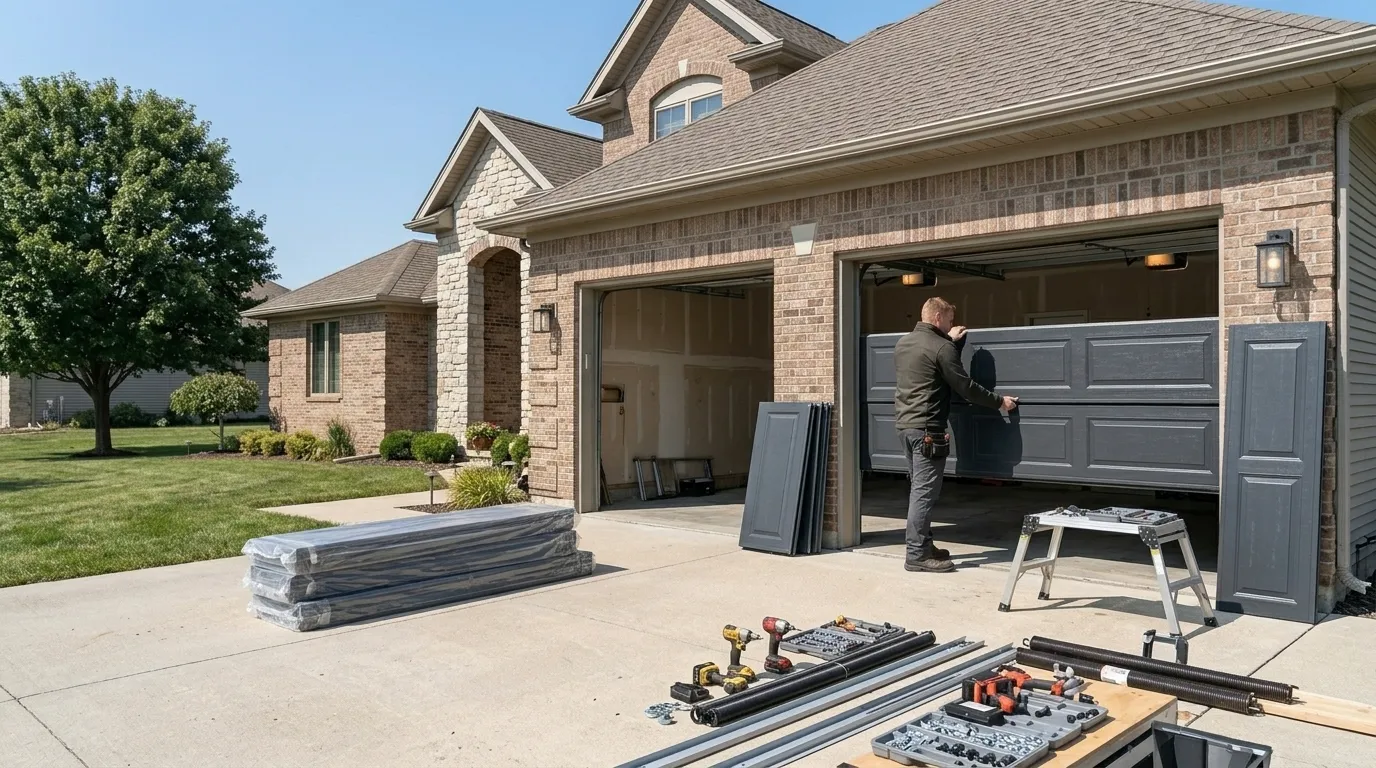
A standard single-door swap on an existing opening usually runs a half day, start to finish - old door off, new door hung, springs set and balanced, opener re-mounted if you're keeping it. Double doors or anything where we're widening the opening to match current sizing takes longer, often a full day, because the jambs and header need work too.
We won't promise a same-day job on every call. If you're ordering a specific panel style or a insulated door in a size that isn't sitting on the truck, the door itself is the lead-time item, not our labor. That's the one honest limit here: we can schedule the install fast, but we can't make a factory ship faster than it ships.
Houses in this area built in the 1960s and 70s often have openings sized to doors that aren't made anymore, so part of the first visit is just confirming what will actually fit the frame you have before anything gets ordered.
If you're looking at installation rather than repair, you're probably seeing one of a few things: a door that still runs but is single-layer steel with no insulation, a wood door from the original build that's swelling and sticking in its track, or a door that's been patched enough times that the hardware doesn't match anymore. None of that is an emergency. It's a door that's done its job for decades and is now costing you in draft, noise, or a stuck panel every winter.
Some owners are also seeing an opening that's simply undersized for what they want now - a two-car opening that was built as two separate single doors, for instance, common in this area's older stock. That's not a repair question at all. It's a construction question, and it changes the job from swapping a door to reframing an opening.
Either way, the tell is usually the same: the door still moves, but it doesn't fit the house anymore, in size, in insulation, or in what it costs you to run it every month.
Housing in this service area was mostly built between 1950 and 2004, with the median landing around 1977 and the heaviest concentration in the 1960s and 70s across the fifteen named neighborhoods we cover. That matters for installation because doors and openings from that era were built to specs that don't match what's sold today - narrower panels, no insulation core, hardware sized for a lighter door.
The climate here is the other half of it. We sit in a cold-moderate band, which means real freeze-thaw cycles every winter. A door built without a thermal break or weatherstripping designed for that swing will warp, stick, or let cold air roll straight into an attached garage. On a 1970s-era door, that's not a defect - it's just what a 45-plus-year-old panel does in this weather.
So the pattern we see is straightforward: original or early-replacement doors from that 1950-2004 build window, still functional, but past the point where insulation and fit make sense to keep patching. Installation at that point isn't about a broken part. It's about a door that's aged out of the house it's on.
Hanging a garage door yourself is not the same job as most home projects, and the reason is the torsion spring, which stores enough force to break bones or worse if it lets go while you're working near it. That's true of any door, any town - but it's worth saying plainly because a lot of the doors we're replacing in this area are original to houses built in the 1960s and 70s, and homeowners sometimes assume an old door means a simple door. It doesn't.
What you can reasonably do yourself: measure your opening, decide on insulation level and panel style, and have that conversation with us before we quote anything. What you shouldn't do yourself: set spring tension, cut or resize a jamb, or wire a new opener into an old track system that wasn't built for it.
We'll tell you straight if a job is a smaller fix than a full install - if your existing frame and hardware are sound and it's really just the panel that's failed, replacing the whole opening is more work and more cost than the problem calls for.
It depends on door size, insulation, and whether the opening needs to be resized, so we can't give a number without seeing it. We'll walk your opening, talk through panel and insulation options, and give you a firm quote before any work starts.
Often, yes. A lot of houses built in the 1960s and 70s have openings sized differently than current standard doors, especially on two-car garages built as separate single openings. We check actual opening dimensions before ordering, not just the door you're replacing.
You can prep and choose the door yourself, but setting spring tension and fitting the door into an old jamb is not a safe DIY job - torsion springs store enough force to cause serious injury. We handle that part on every install.
An insulated door with proper weatherstripping makes a real difference here, given the freeze-thaw winters this area gets. An older single-layer door from the 1970s or earlier has no thermal break at all, which is usually the biggest gap in an attached garage.
Call now or request a free quote - same-day service on most repairs, upfront written pricing.