Overland Park, KS · Garage Door Service
Leawood homes built mostly after 1989 run newer opener electronics and steel doors, not the older stock common closer to Overland Park. We travel 4 miles to work on them.
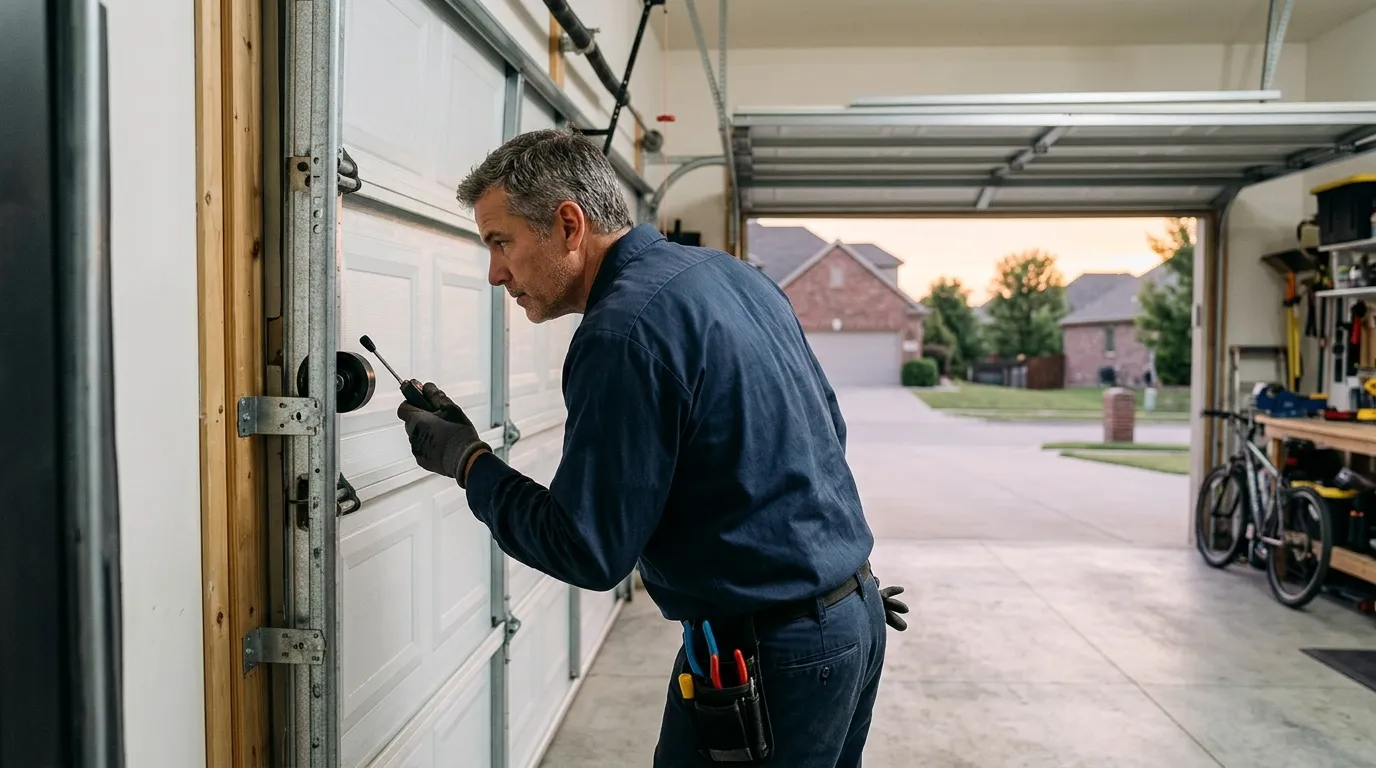
Leawood's median home was built in 1989, a good decade or two newer than the 1950-2004 spread across the wider service area. That gap matters more than it sounds like it should. A house from 1989 almost never has the old side-mounted torsion setup you find on the 1960s and 70s stock that makes up most of the area. Instead you're looking at center-mounted torsion springs over the header, steel doors instead of wood, and openers that are more likely to have circuit boards than pure mechanical relay logic.
That means fewer of the "nobody stocks this bracket anymore" calls and more calls about failing logic boards, worn nylon rollers, and openers that are old enough to need a new gear kit but not old enough to be a museum piece. It also means when a spring does go, it's usually a standard size we can match off the truck rather than something obsolete.
We come out of Overland Park, about 4 miles away, so nothing about the drive changes how we work. It just means the doors we see here skew newer than what we see elsewhere, and we plan the parts we bring accordingly.
On a late-1980s or 1990s door, the two calls we get most are opener failure and torsion spring replacement on steel doors that have never needed a panel swap. The openers from that build era are old enough now that chain drives strip, capacitors on the logic board die, and remotes stop syncing reliably. Often it's cheaper to replace the opener outright than to keep chasing intermittent faults on a 25-30 year old unit.
With household income here at $184,976, a fair number of these calls end in full opener upgrades rather than patch repairs, since the cost difference between a repair and a new belt-drive unit is smaller relative to what people are willing to spend to stop dealing with a flaky door. We still fix what's fixable first and say so.
We also see standard torsion spring failures on steel doors, and worn bottom brackets on doors that have had 30-plus years of daily cycles. Track misalignment shows up too, usually from a bumped door rather than age. None of this is exotic work, it's just skewed toward opener electronics and standard hardware sizes instead of the obsolete parts problem you get on older stock.
Leawood has roughly 13,174 households, and most of the homes behind those doors were built well after the older wave that dominates much of the surrounding area, where the median build year runs closer to 1977. That later construction date shows up directly in the doors: heavier-gauge steel sections, factory-insulated panels in a lot of cases, and openers built for modern safety-reversal standards rather than retrofitted onto older track.
The practical upshot is that when something breaks here, it's rarely a hunt for a discontinued part. Spring sizes, track widths, and opener mounting are close enough to current standard that we're not improvising. What we do see more of is wear from age on doors that have simply been cycled for three decades without major service - dried-out hinges, rollers that were never replaced, openers running on original gearing.
It's a different maintenance profile than the older neighborhoods nearby, and it's worth knowing that going in, whether you're calling about a noisy door or budgeting for an eventual opener swap.
We don't keep a depot or a crew stationed in Leawood - we run out of Overland Park, about 4 miles away, so if you need same-hour emergency service outside our normal routing, we may not be the fastest option on a given day. We also don't try to force a repair on a door that's past it; if a steel panel from the late 80s is rusted through at the bottom or the track is bent beyond a clean realignment, we'll tell you replacement is the better spend rather than billing you for a patch that won't hold.
We don't do wood door refinishing or cosmetic carpentry - if the issue is the door's finish rather than its mechanics, that's outside what we handle. And we don't guess at parts sight unseen over the phone; a spring size or opener model quoted before we've looked at the door is a rough estimate at best, not a number to build a decision around.
Yes. The median home here was built around 1989, noticeably newer than the roughly 1977 median across the broader area. That means more standard-size torsion springs and steel doors, and fewer of the obsolete parts issues that come with 1960s and 70s hardware.
No. We run out of Overland Park, about 4 miles away, and travel to Leawood for jobs. There's no local depot or standing crew here, so scheduling runs through our Overland Park dispatch.
Not automatically. If it's cycling reliably and the safety reversal still works, there's no need to replace it just for age. We'll test it on-site and tell you honestly whether it's a repair, a wait-and-watch, or worth swapping.
Usually not. Doors from the late 80s and 90s tend to use standard torsion spring sizes, which is different from some of the older 1960s stock nearby where obsolete brackets and spring lengths are more common.
Call now or request a free quote - same-day service on most repairs, upfront written pricing.